
Waves, Layers, Lessons: More Stories of Dr. William Kuperman
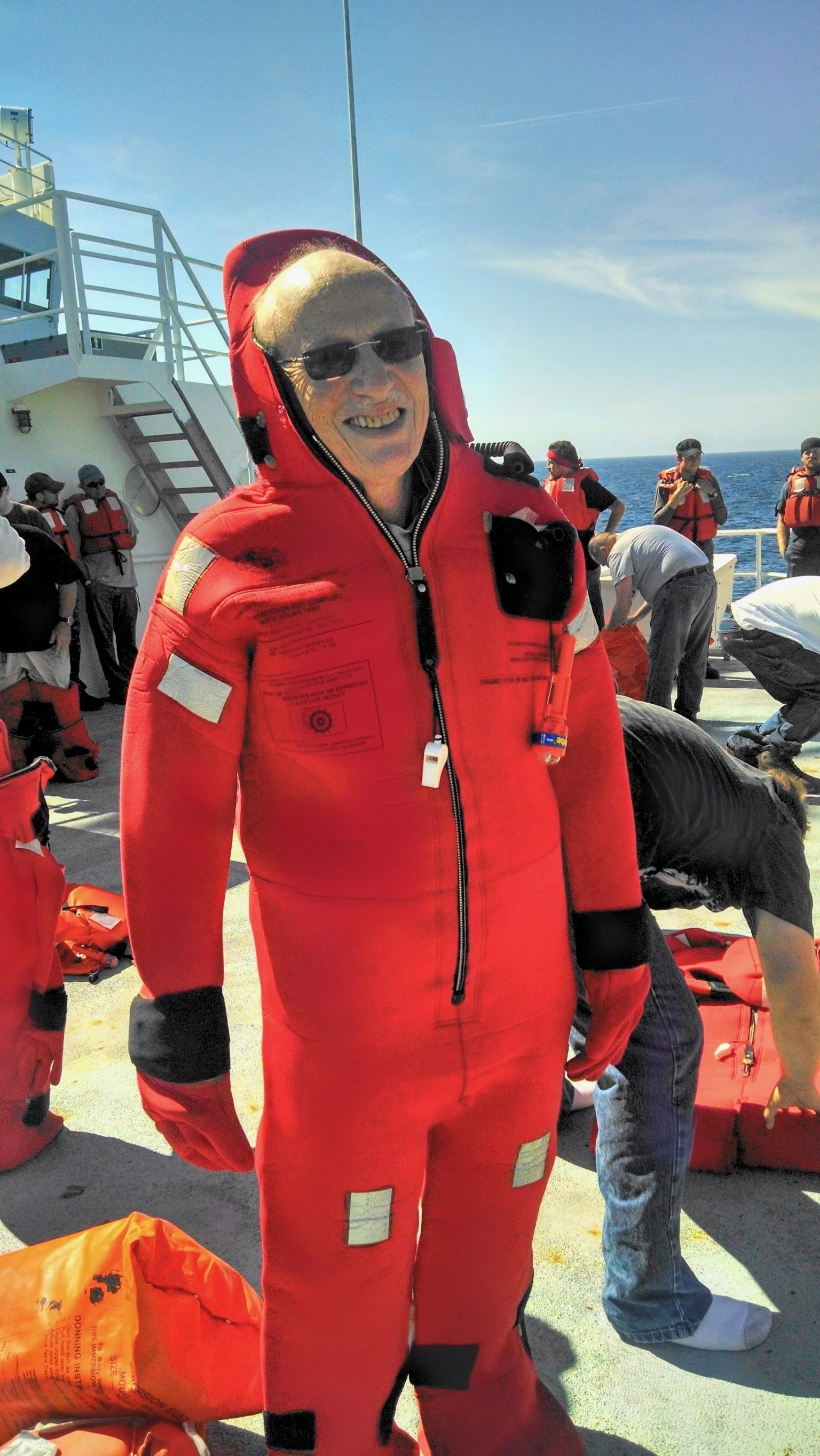
Bill during a research cruise aboard the R/V Melville in 2014, participating in a safety training drill, wearing a Gumby survival suit.
Photo courtesy of Dr. Jit Sarkar.
Continuing my tribute to Dr. William A. Kuperman, one of the founding fathers of computational ocean acoustics, a scientist, advisor, mentor, and professional father figure whose influence continues through the lives he touched.
From Scripps to the Pentagon: Humor, Human Connections, and the Lasting Ripples of Mentorship
Nearly a year ago, after I shared my first reflection about Dr. Bill Kuperman and his mentorship, Dr. Timothy (Tim) Gallaudet and I connected on LinkedIn. Tim, a retired U.S. Navy Rear Admiral, oceanographer, and former Acting Under Secretary of Commerce for Oceans and Atmosphere, was kind enough to set aside time for a conversation and to share his memories of Kuperman.
We came to that conversation from very different paths: his long career in the U.S. Navy and oceanography, and mine as a researcher who came from Türkiye to pursue her PhD, learning along the way to find and trust her own voice. As we talked, however, the overlaps began to appear.
Tim earned his master's degree in oceanography at Scripps Institution of Oceanography (SIO) in 1991. Following several Navy assignments, he returned to Scripps in 1997 to pursue his PhD under Dr. Christian de Moustier, completing it in 2001. Kuperman served on his dissertation committee.
Another connection surfaced through Tim's wife, Caren Gallaudet, who also earned her master's degree at Scripps in 2001. After connecting with Caren on LinkedIn following my earlier tribute to Kuperman, I learned from her that her advisor had been Dr. William Hodgkiss, who was also one of my PhD mentors and dissertation committee members.
Both Tim and Caren had graduated seven years before I began my PhD at Scripps in 2008. We belonged to different generations of students connected to the Marine Physical Laboratory (MPL) at Scripps, and our professional journeys took different directions. Yet, we were linked through the same academic community and mentors. What began as a conversation with Tim about Kuperman naturally expanded into memories of Scripps and the people who had influenced us along the way.
During that conversation, Tim generously shared two stories about Bill. One made me laugh. The other revealed an unexpected connection between underwater acoustics, scientific mentorship, and leadership in the U.S. Navy.
I've been meaning to write these stories down ever since. Better late than never. Here we are, almost a year later.
Story 1. The Hat: Bill Being Bill
Let's begin with the funny one.
Tim recalled a day when he and a fellow student were sitting in their office at the Institute of Geophysics and Planetary Physics (IGPP) at Scripps. Bill walked into the office wearing a hat. Tim and his classmate looked at each other and started laughing. Bill, apparently puzzled by their reaction, wanted to know what was so funny. They pointed to his hat, which had a marijuana leaf on it. Bill explained that it was a gift from his son and seemed completely unaware of what the symbol represented. He was simply wearing a hat his son had given him.
I laughed when Tim told me this story. Anyone who knew Bill can probably picture the scene: here was an internationally respected scientist, known for his extraordinary intellect, precision, directness, and occasionally grumpy appearance, casually walking into an office wearing a marijuana-leaf hat, unaware of why his students were laughing.
Or perhaps he knew? :) Knowing Bill's sense of humor, I wouldn't entirely rule that out either. In Tim's recollection, Bill genuinely seemed to have no idea, which makes the story even funnier.
In my original tribute, I wrote about the contrast between Bill's sometimes intimidating exterior and the deeply caring, funny, and wonderfully human person underneath. This story brought that contrast to life again, and a reminder:
Not every meaningful memory from our academic and professional lives comes from a scientific discovery, a successful project, or an important conversation. Sometimes, if not more, it's a funny hat, a shared laugh in the office, or a spontaneous moment that stays with us for decades.
I love that Tim remembered and shared this story, and I'm grateful he did.
Story 2. From Scripps to the Pentagon: An Unexpected Scientific Connection
The second story Tim shared was quite different. He generously sent me a PDF of his then-forthcoming book, Holding Fast in Heavy Seas: Leadership for Turbulent Times (published in July 2026), where he mentioned Bill in a footnote tied to an important moment in his Navy career.
In early 2016, Admiral John Richardson, then Chief of Naval Operations (CNO) of the U.S. Navy, called Tim to the Pentagon. Richardson was preparing to offer Tim a significant leadership opportunity to “lead across,” which Tim refers to as influencing one’s peers.
As Tim described the meeting, the two men had something interesting in common. Both had pursued graduate studies at leading oceanographic institutions. Richardson had earned a graduate degree through the joint program between the Massachusetts Institute of Technology (MIT) and Woods Hole Oceanographic Institution (WHOI), while Tim had earned his master's and doctoral degrees at Scripps.
But the connection went further. Their academic mentors had coauthored a textbook chapter on underwater acoustics.
Dr. Arthur Baggeroer, Richardson's advisor at Woods Hole, and Dr. Bill Kuperman, a member of Tim's dissertation committee at Scripps, had coauthored a chapter, “Matched Field Processing in Ocean Acoustics”, published in 1993. Tim identified the two scientists and their respective roles in a footnote in his book.
The broader story concerned the strategic importance of ocean science to U.S. naval operations. Richardson had heard concerns from prominent marine scientists that China and Russia were potentially overtaking the United States in their understanding of the ocean. The Navy's capabilities in submarine detection, mine countermeasures, and other underwater operations depended, in part, on maintaining scientific expertise and leadership in ocean science. For Tim, a career oceanographer, the opportunity represented a significant moment in his professional journey. And within that larger story was a small footnote connecting two academic mentors.
When Tim shared this story with me, I found myself smiling. There was Bill again.
Decades earlier, two scientists had collaborated on underwater acoustics. Years later, the professional journeys of two people they had mentored intersected at the Pentagon. I found it fascinating how those connections resurfaced, sometimes in ways the original mentors might never imagine.
And there was another layer to my own connection with Tim. About fifteen years earlier, during one of Tim's visits to Scripps, I vaguely remember Bill briefly introducing us. Little did I know then that we would reconnect years later to share memories of the very person who had introduced us.
Life has a fascinating way of bringing people back into our paths.
Beyond Scientific Mentorship: Generosity, Time, and Being Present
Beyond the two stories, something specific about Tim's way of communicating stayed with me. Around the time we connected last year, Tim had extensive professional commitments, including his involvement in public discussions on ocean science, national security, and Unidentified Anomalous Phenomena (UAP) disclosure, his appearance in the documentary The Age of Disclosure and related media interviews. Yet he made time for a thoughtful conversation with me, even with the holiday season approaching. He was approachable, responsive, transparent, and generous with his time, sharing memories of Bill and even sending along his book.
I appreciated that a lot, and it reminded me of Bill.
In fact, we talked about this during our call. One of Bill's remarkable habits was his responsiveness. He was extraordinarily prompt in his communications, whether with students, mentees, colleagues, or collaborators. We often joked that Bill would respond to an email within five or ten minutes. If fifteen minutes passed without a reply, we would start wondering whether something was wrong. Dr. Peter Gerstoft, who worked closely with Bill, once expressed similar concern when he hadn't heard back from Bill for about fifteen minutes.
This may sound like an exaggeration, but anyone who worked closely with Bill will probably recognize it. He was fully present, accessible, engaged, and proactive in his communication, consistently responding to requests for advice, feedback, or guidance despite his many responsibilities.
Of course, responsiveness alone does not define good mentorship or leadership, nor should anyone be expected to remain available at all times. But with Bill, this habit reflected something deeper. He made people feel that their questions, concerns, thoughts, and progress mattered. Helping us think, learn, solve problems, and grow wasn't an interruption to his work. It was an essential part of it. He invested wholeheartedly in his mentees, helping prepare them to become independent thinkers and future leaders.
I recognized a similar quality in Tim's willingness to make time for our conversation. I'm not suggesting that Tim necessarily learned this particular habit from Bill. Rather, I recognized in Tim something I had deeply appreciated in Bill: the willingness to be accessible, transparent, and generous with one's knowledge, experiences, attention, and time, with intention. To me, this is an important quality of good mentorship and leadership.
For better or worse, Bill's example has also shaped how I communicate and how I perceive responsiveness in professional relationships. I've encountered similar proactive communication here and there over the years, but not to the same extent until I began working at a Musk company. When I recognize this quality in others, I tend to resonate with their way of thinking and working. To me, proactive communication is essential not only to effective leadership but also to meaningful progress and productive working relationships.
It is a quality I value enormously and one I hope to continue practicing and improving in myself.
🌊 Closing Reflections: The Stories We Carry Forward
At first glance, Tim's two stories may seem unrelated. One involves a marijuana-leaf hat and two students laughing in an office at Scripps. The other involves senior Navy leadership at the Pentagon, ocean science, and scientific connections spanning decades.
Yet both reveal different dimensions of Bill's influence: the humor and humanity behind his scientific achievements, and the connections that his work and mentorship helped create across generations and professional paths.
Through Tim's recollections and our conversation, I also caught a glimpse of Tim’s own humor, thoughtfulness, and care, qualities I appreciated despite our limited interactions. His generosity in making time to connect, exchange memories, and share experiences made our conversation all the more meaningful.
Perhaps one of the most meaningful aspects of mentorship is what continues to ripple through people's lives long after the formal mentorship has ended.
Thank you, Tim, for your generosity, your time, and for sharing these memories of Bill. I'm grateful our paths crossed again.
And Bill, once again, thank you.
🌿 SYNCHRONICITIES AND WHAT COMES NEXT
When I began my original tribute to Bill, I intended it to remain a living space for memories and reflections. This is another layer, and I'm grateful to Tim for contributing to it.
There are still many stories to tell, and I'll continue writing them when the flow state calls me in. If you have stories of Bill you'd like to share, please reach out.
Until next time...
– With care 🌊
Written by Zelda – Dr. Selda Yildiz, in reflective dialogue with her AI muse, Amea.
Original tribute: Dr. William A. Kuperman: A Tribute
Tim's book: Gallaudet, T. (2026). Holding Fast in Heavy Seas: Leadership for Turbulent Times. Koehler Books.
Scientific reference: Baggeroer, A.B., Kuperman, W.A. (1993). Matched Field Processing in Ocean Acoustics. In: Moura, J.M.F., Lourtie, I.M.G. (eds) Acoustic Signal Processing for Ocean Exploration. NATO ASI Series, vol 388. Springer, Dordrecht. https://doi.org/10.1007/978-94-011-1604-6_8
Guest insights appear with permission and attribution.
© 2026 Selda Yildiz | Yildiz Oceanic Well-Being | All rights reserved.
No part of this content may be reproduced, distributed, or used for commercial purposes without prior written consent from the author; copying or reposting content without permission is not permitted. Link sharing through social/online-media platforms is welcome when the original source is credited – may this reflection ripple forward with care and integrity.
✨ Disclaimer: This post is for general educational purposes only. It is not medical advice, nor a substitute for professional consultation, diagnosis, or treatment. If you have concerns about your health, please seek guidance from a qualified healthcare professional.
Our Guest Tides and Currents bring fresh perspectives – not endorsements or promotions, but explorations and invitations to dialogue in support of sustainable well-being.