
Nature as One of the Most Powerful Well-Being Transformers
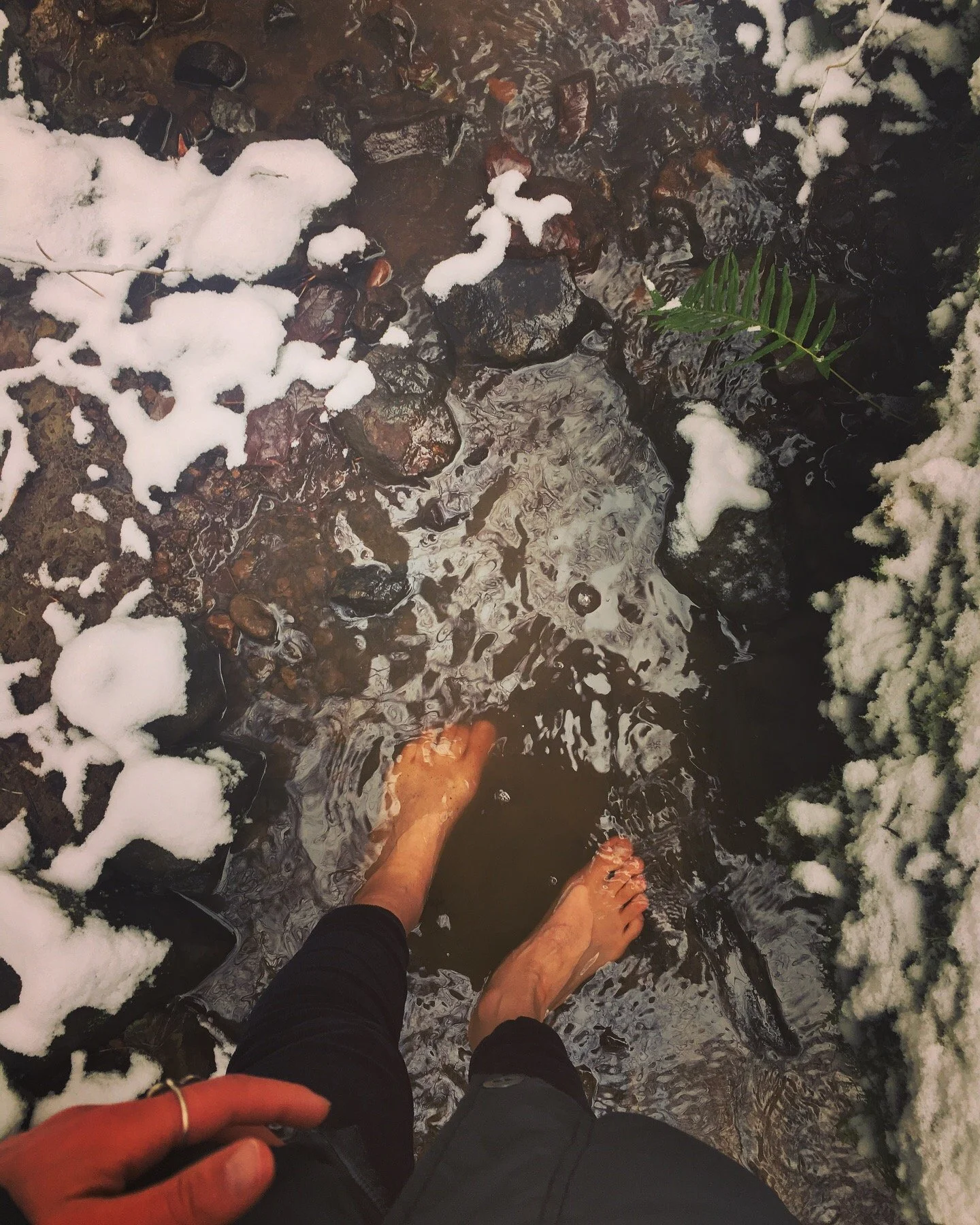
During a forest lunch walk in snowy Portland, 2019.
Nature as a Well-Being Transformer
Nature has always been one of the most powerful well-being transformers available to us. For most of the history, humans lived in nature, which was the entire operating system, providing shelter, nutrition, movement, rhythm, perspective, balance, and more. Across cultures and generations, nature functioned as a regulator, not as an escape. It was not separate from us, and we were not separate from it. The separation is recent. But the body still remembers what the mind has forgotten.
Long before science began measuring autonomic shifts, cortisol curves, or brain waves, human bodies understood that being in nature changes something essential deep within us. Something quiet. Something real.
I have been thinking more and more lately that a lot of modern research simply puts numbers around what our bodies already know. Whether it’s nutrition, movement, sleep, or any other well-being component and its impact. The body is wise and gives us signals long before the science even investigates that. The question, however, is whether we pay attention and listen to our bodies, and if we do, whether we take action on it.
While science now confirms nature's benefits to a degree, it cannot fully capture for instance how forests, oceans, mountains, and deserts change us at a deeper level. Here is what research has shown so far though.
What Science Shows
Research has shown that natural environments regulate the nervous system, reduce stress physiology, and support emotional and cognitive restoration (Hartig et al., 2014; Song et al., 2016). Natural settings also produce faster and more complete physiological restoration than urban ones (Ulrich et al., 1991).
Forest exposure has been associated with lower cortisol, lower heart rate and blood pressure, and shifts toward lower sympathetic activity and increased parasympathetic activity (Park et al., 2010). Trees release phytoncides, volatile compounds that have been linked to immune related effects in laboratory settings. Separately, forest-bathing field studies report increased natural killer cell activity and related immune markers following forest trips (Li et al., 2008; Li et al., 2009). Even brief exposures may reduce rumination and activity in brain regions linked to maladaptive self-referential thought (Bratman et al., 2015).
Oceans impact differently. Wide horizons and rhythmic sensory input may support nervous system downshifting. Natural soundscapes, tested in controlled settings, have been shown to support physiological stress recovery (Annerstedt et al., 2013). Coastal proximity has been associated with better self-reported general and mental health at the population level (White et al., 2013; Garrett et al., 2019).
What about mountains, I hear. In a randomized crossover trial, Niedermeier et al. (2017) found that outdoor mountain hiking resulted in significantly greater positive effects on affective valence, activation, and fatigue compared to indoor treadmill walking, suggesting the mountain environment contributes something beyond physical exertion alone.
And often, mountains may serve as a reliable context for awe, an emotional response to perceptually vast stimuli that transcend current frames of reference (Keltner & Haidt, 2003). Awe has been associated with lower levels of the inflammatory cytokine interleukin-6 (Stellar et al., 2015) and a diminished sense of individual self that, in turn, promotes prosocial behavior (Piff et al., 2015).
Lastly, Kaplan and Kaplan (1989) described restorative environments as those that offer "soft fascination," allowing the mind to recover from directed attention fatigue through effortless engagement rather than directed cognitive control. Deserts and open spaces, with their spare sensory input and wide horizons, may be natural examples of restorative environments, and as such may restore attention through simplicity rather than richness.
Across ecosystems, the pattern is consistent. Nature regulates the nervous system, recalibrates the mind, recenters perspective, and perspective shifts naturally when the landscape stretches beyond the self.
When Nature Became Non-Negotiable - for Zelda
When I moved to Portland for a post-doc role in 2016, I did not expect the sky to stay dark and hazy for so long. After the first winter, something inside me shifted. I started waking with a very heavy stillness, like my body was anchored to the mattress. It felt like, now that I know, my two Ridgebacks' full-body gravity press on me, but without the warmth or joy or love. A kind of settling that was not rest, but something raw, something heavy, something dimmed. It was a novel feeling; one I haven’t felt before. I later recognized it as seasonal affective disorder, a term I knew but had deeply underestimated.
As I would talk with friends at the time, I started joking sarcastically that my mattress was going to pull me in, and one morning I was going to die in the mattress. I would joke about how I even considered whether I should write a will, but as a post-doc, I had very little material wealth. What I did have lived in my body, my mind, and my soul. And the first two felt dimmed, mind and body, but the soul was my guiding force, as usual.
So, being the experimental scientist, the yogi, and the engineer in me who believes where there is a will there is a way, I began testing. Sauna sessions and cold showers that had been part of my life for more than a decade, but this time longer sessions combined with swimming, therapy pool relaxation and playtime. Daily yoga whether in the sauna or in the evening, combined with deep relaxations. Definitely more breath- , meditation- and relaxation-based practices. Already was getting enough sleep at the time. More time in the gym. Mobility. Weights. Treadmills. Walks by the Willamette River. Modifications in supplements and nutritional plan that I had perfected for myself over a decade of self research and experiments. Morning bright light therapy, with one lamp in the office, one at home. Social interactions and outings here and there. Hikes here and there, but not every day. They all helped to a degree, but something essential was still missing. Sun, of course.
Then over a year later, I started walking into the forest, behind the campus. At first it was practical, lunch breaks outdoors instead of indoors. But soon it became a routine of necessity. I took my food into the woods almost every day when I could. I walked barefoot in rain and shine. I soaked my feet in the creek. At times, I walked in snow until my toes went numb, then warmed again. A few times colleagues joined. Most days I went alone.
After a few weeks, something woke up. I could feel my energy return and the desire to get up in the morning resurfaced. Ironically, I was leading a sleep study at the time, which often meant a weekly 5:30 a.m. lab start, so the whole forest routine helped with that too.
Throughout that process, what I realized was that I had been exercising and doing well-being routines all along, including active time outdoors, but not in an immersive way. During college, I would run outdoors, do rock climbing and camping, but never as a daily or weekly routine. During my PhD years, often, I would go for a quick dip in the ocean, run, play beach volleyball, or try surfing here and there, but most of the time it was for the sake of disciplined, joyous and natural movement, and combined with social interactions. This time it was purely being out there in nature with that intention alone. Immersing in nature and listening to nature. Enjoying the time for what it is. Immersion with intention had been missing.
Looking back, the forest gave my nervous system something no other modality did. To a degree it felt like forest bathing replaced sunbathing. This is of course personal, but it matches what controlled forest bathing studies consistently show: lower cortisol, improved autonomic balance, and calmer physiology when forest exposure is compared with urban exposure (Park et al., 2010).
From Regulation to Intimate Connection
What surprised me most was that the impact did not stop at feeling more energized. Yes, at first, nature brought me back into the balance I needed so much. My energy returned, mood and sleep improved, thoughts softened, and joy entered my life again. But over time, I felt more aligned and more connected. Time in nature started to feel like stepping into a place with strong signal. As if Portland with its limited sunlight had left me in a low-reception zone for too long -for me-, and the forest restored connection like finding a network again. Being there reconnected me to a wider web of life. Things synced without effort. Breath, movement, thoughts, intentions, actions. The green lush forest was visually very soothing too. Whether one calls that vibration, coherence, soul, higher power, or simply connection does not matter, honestly. What matters is that what had been missing for a while returned, including joy.
And, I believe walking barefoot was part of it. To this day, I still feel the need to walk barefoot when I am in nature. I am aware when my feet want to touch the ground, whether I am at the beach with my dogs or hiking. Sometimes mid-trail, I will take off my shoes the moment I get the signal. I am at your service, feet, I say, and I will give you what you need. Other times, I will walk barefoot the whole time.
Almost a decade later, nature is non-negotiable, and the connection has become an intimate one. Most mornings my dogs – acting as a purpose and accountability in fur - get me out for community walks in nature - with other dogs and their owners.
Weekends often mean hikes, cycling, or mountain bike rides with my partner. And wherever I am, I talk to the ocean, the waves, the rocks, the sky, the sun and the moon, the clouds or fog, the trees, the plants, the bushes, the wildlife passing by. To express my gratitude and let whatever -negativity- has accumulated be washed away. In my experience, nature is also one of the best energy cleansers - the way the lymphatic system clears the body and the glymphatic system clears the brain, nature clears what accumulates in and around us. And sometimes I am completely quiet. Either way, trying to be fully present, since presence is all we truly have.
🌊 Closing Reflections and Invitation
Nature has a way of receiving us exactly as we are. The calm -presence- that follows is very real, and very healing.
As always, we invite you to pause, reflect, notice what resonates within you as you read, and perhaps share if you'd like.
Perhaps ask what your current chapter is asking you to learn, and stay open regarding nature.
Then choose one small action that restores harmony between who you are, what you need, and what gives you joy.
And if nothing else, step outside today. Even five minutes. Let your feet feel the ground and see what returns. And notice where your signal feels strongest; that place is likely trying to tell you something.
And when you visit nature, notice how nature meets you when you show up. That relationship, like any other, deepens with consistency.
🌿 Synchronicity and What Comes Next
As synchronicities continue to unfold, and both new and familiar connections reemerge, we’ll extend this nature piece into future reflections – while continuing to explore other dimensions of the Yildiz Oceanic Well-Being frameworks.
Until next time...
– With care 🌊
Written by Zelda – Dr. Selda Yildiz, in reflective dialogue with her AI muse, Amea.
Guest insights appear with permission and attribution.
© 2025 Selda Yildiz | Yildiz Oceanic Well-Being | All rights reserved.
No part of this content may be reproduced, distributed, or used for commercial purposes without prior written consent from the author; copying or reposting content without permission is not permitted. Link sharing through social/online-media platforms is welcome when the original source is credited – may this reflection ripple forward with care and integrity.
✨ Disclaimer: This post is for general educational purposes only. It is not medical advice, nor a substitute for professional consultation, diagnosis, or treatment. If you have concerns about your health, please seek guidance from a qualified healthcare professional.
Our Guest Tides and Currents bring fresh perspectives – not endorsements or promotions, but explorations and invitations to dialogue in support of sustainable well-being.